




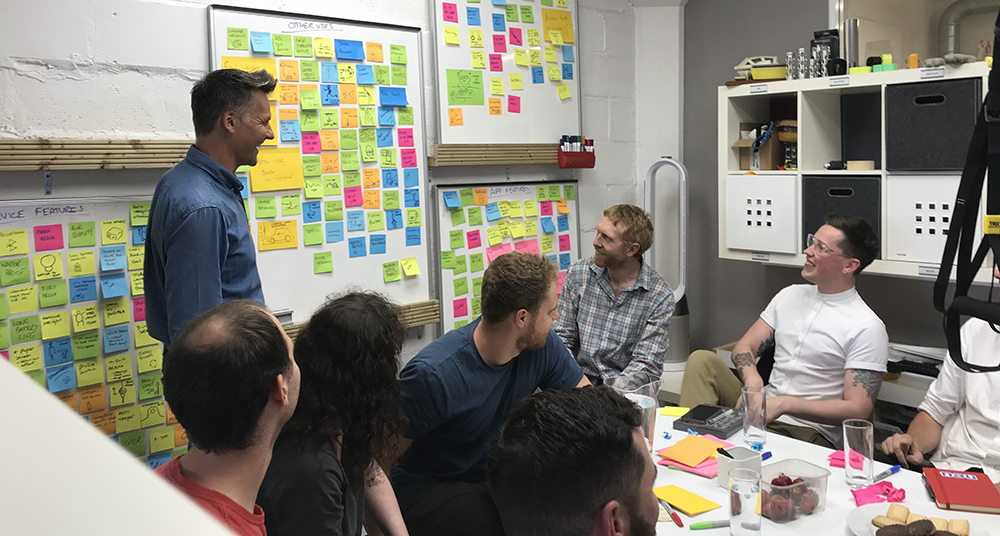
At 4c Design, innovation is not just a ‘bolt-on’ service. It’s a partnership.
Founded in Glasgow and led by Managing Director Will Mitchell, 4c has spent over two decades helping organisations turn complex ideas into meaningful, market-ready solutions. Their defining belief is simple but often overlooked: innovation only matters if it adds real value.
“The failure rate of new product development is still alarmingly high,” says Will. “Most projects don’t fail because of bad ideas, but because the right questions were never asked early enough.”
Rather than arriving late to execute a brief, the team embeds early, working with clients to understand why a product should exist before deciding how to make it. Value, in 4c’s terms, might mean new revenue, reduced cost, improved experience, or a more desirable and responsible product. The best outcomes achieve all four.
Central to this approach is what Will describes as “building to think.” While many consultancies remain trapped in theory, 4c has invested heavily in hands-on prototyping and engineering. Physical prototypes – whether rough cardboard mock-ups or high-fidelity models – allow ideas to be tested, challenged, and refined early.
“If a picture is worth a thousand words,” Mitchell notes, “a prototype is worth a thousand more.” It’s a practical interpretation of the “fail fast, fail cheap” mindset – discovering what doesn’t work before significant time, money, or materials are committed.
But innovation isn’t just about process; it’s about culture. 4c frames its work around four pillars: Leadership, Risk, People, and Environment. Before sketches or specifications appear, the team ensures a business is genuinely ready to innovate; aligned on direction, ownership, and appetite for uncertainty.
To manage risk and build confidence, 4c adapted NASA’s Technology Readiness Levels, breaking innovation into clear, incremental stages. Crucially, they begin with what they call TRL 0: defining the necessity of the project itself. “Every decision that follows depends on getting the first step right,” says Mitchell.
Integrity also plays a defining role. 4c is selective about the work it takes on, guided by a principle not to “add to the problem.” From improving safety in extreme environments to enhancing animal welfare and accessibility, their projects are chosen for impact, not novelty.
“At the core of what we do is derisking innovation,” Mitchell reflects. “For our clients, for users, and for the world we’re designing into.”
4c Design is not naive to the realities of time and cost, but believe the greatest risk lies in rushing forward without first stopping to think.
For more information:
0141 353 5490
