




By Isabelle Cox, Data Analytics Assessor, Direct Partners Training Provider
In a world constantly evolving, one truth is becoming harder to ignore: data sits behind almost every important decision. Whether you are a manager reviewing performance figures and tracking progress, a health professional observing patient outcomes, a fundraiser building evidence for a grant proposal, or a business owner deciding where to take your organisation next, the need to understand and use data is no longer limited to analysts and IT departments.
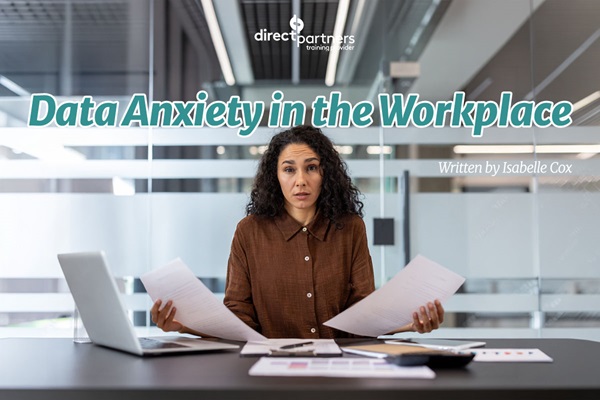
However, confidence in handling and analysing data has not kept pace. For many, facing a dataset brings not curiosity, but unease, even fear. A fear of getting something wrong, of lacking statistical knowledge or of not being ‘a numbers person’. This anxiety – known as data anxiety – is far more common in workplaces than we tend to admit.
Feeling Unready for Data
Government-commissioned research found that over a third of UK workers surveyed felt their level of data skills left them feeling ill-equipped for their current role (Source: DCMS, 2021). This was not only a problem for people in their early careers. Almost half of senior managers and directors felt the same, and half of all workers had received no data skills training in the previous two years, despite expressing their interest (Source: DCMS, 2021). Feeling unprepared for data analysis is widespread, affecting many people, roles and organisations, and can feed data anxiety.
Learning on the job without the proper support can bring many challenges that contribute to data anxiety, from working on spreadsheets you don’t understand to guessing whether your chart will show what you need, all while quietly hoping nobody will ask you for justifications on your numbers or statistics. Canva’s 2025 report found that two thirds of the sales and marketing professionals surveyed experienced data anxiety, even where data literacy training was offered (Source: Canva, Beyond the Numbers, 2025). Providing training, it seems, is not enough on its own.
Confidence Grows with Safe Mistakes and Feedback
What may matter is the kind of training. In government research, workers reported that training relevant to their day-to-day role improved their productivity and reduced their stress (Source: DCMS, 2021). As an Assessor I have seen something similar first hand. When people are first introduced to data cleaning methods, coding software and data structures, for many, alarm bells ring, they panic, and start distancing themselves from the data. However, through being walked through the concepts by a specialist, gaining the reassurance that they can make mistakes without consequence, and receiving helpful, constructive feedback on their work, their confidence begins to build. They start feeling ready to begin trying and open to make the mistakes that will help them learn. This first step is vital in reducing data anxiety. Bringing all this together in one space is hard, and that is where Modern Apprenticeships can help.
The Role of Modern Apprenticeships in Reducing Data Anxiety
Modern Apprenticeships are designed to help our current workforce upskill in an encouraging and supportive environment. Learners are given the chance to learn whilst they work, with learning happening on their own data and in their own job. They build knowledge and understanding, alongside practical skills, and in our case, training costs are covered by Skills Development Scotland for eligible learners.
Blended delivery models, including self-study, 1-1 support, practical sessions, projects and observations, enable learners to guide their learning journey with their Assessor and have access to support when they need it. Each element does an important job. Self-study allows learners to work at their own pace, so they can fully grasp any challenging concepts they are facing. The 1-1 support means there is always someone there to ask technical questions, easing the fear of getting things wrong. Practical sessions, projects and observations take place to help learners apply their learning to the real world from the start. Together, they provide an environment where mistakes are safe and feedback is constructive, without leaving anyone to cope alone.
What I See in Our Leaners
The clearest evidence comes from the learning journey of our learners. As an Assessor, I have seen their confidence and capabilities noticeably grow as they work through the modules. For many, their end of course project is a great display of that, and a chance for them to apply their learning in their work and evidence this to their employer.
Many begin their journey with the anxieties and worries outlined at the start of this article, that, put simply, data is unattainable to them. What they describe and I see afterwards is not only a key moment in their learning but also their personal and professional development. They are now able to locate and structure the data they work with, plan analysis, transform and visualise their data, and automate their workflows to produce reports and communicate their findings. Each stage is proof that they are capable.
Whilst data anxiety might not disappear, it can be eased and confidence can build. It does not have to be something that holds people back, instead it can be catalyst for individuals to upskill. Modern Apprenticeships provide the opportunity to do just that.
Apply for our Data Analytics SVQ at:
https://directpartners.co.uk/our-services/modern-apprenticeships/data-analytics
Direct Partners is an award-winning training provider based in Edinburgh, delivering SDS-funded qualifications across Scotland. To find out more or discuss a partnership, visit directpartners.co.uk or call 0131 600 0820.
