




When people think about offshore energy, they often picture giant platforms, turbines or drilling rigs. Few stop to consider one of the most fundamental operations taking place every single day: safely transferring people from vessel to installation.
For decades, this has remained one of the industry’s highest-risk activities. Sea conditions change rapidly, vessels move unpredictably, and every transfer carries an inherent level of risk. While technology has transformed many aspects of offshore operations, the challenge of moving people safely between assets remains as critical today as ever.
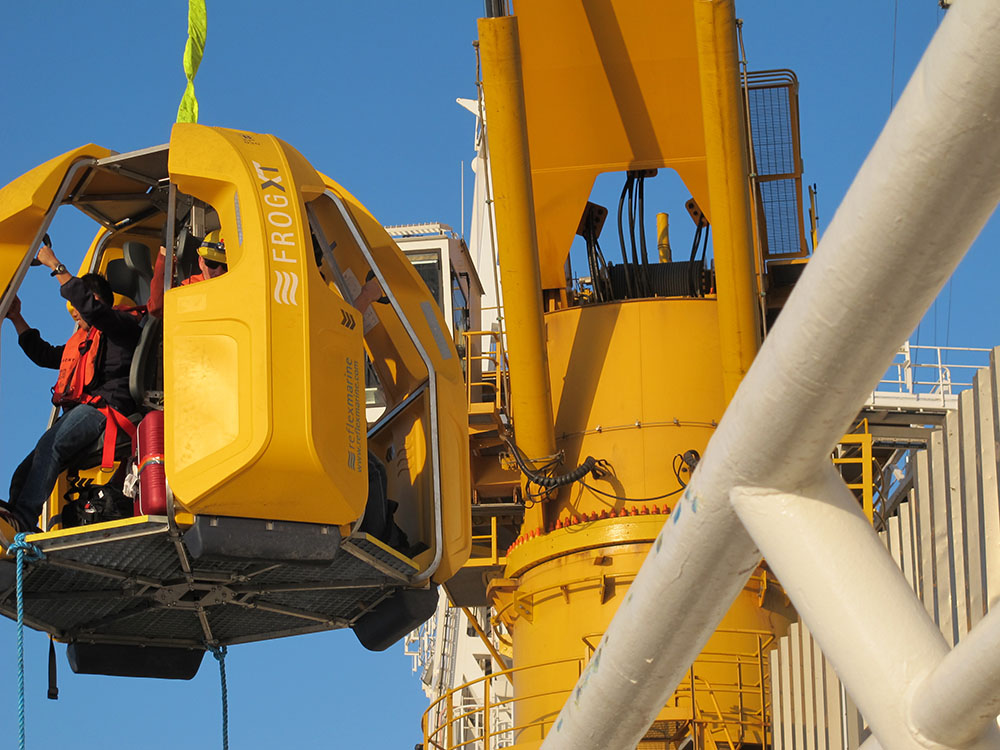
It is precisely this challenge that led to the development of the FROG-XT4.
Designed by Aberdeen-based Reflex Marine and manufactured in Scotland, the FROG-XT4 represents over thirty years of engineering experience dedicated to one objective: reducing risk while improving operational efficiency.
Unlike conventional personnel baskets, the FROG-XT4 was designed from first principles around the passenger rather than the lifting equipment. Every aspect of its design considers what happens when offshore operations are less than perfect—which, in reality, is much of the time.
Its suspended seating system allows passengers to remain securely seated throughout the transfer, helping minimise the effects of impact during landing or vessel movement. Energy-absorbing seating, multiple independent lifting points and a robust structural design all contribute to creating a transfer system engineered specifically for the offshore environment rather than adapted from industrial lifting equipment.
That engineering philosophy has earned the confidence of operators across oil and gas, offshore wind, marine construction and government sectors in more than 85 countries.
The offshore energy sector itself is changing rapidly. Projects are becoming larger, operations more geographically dispersed and weather windows increasingly valuable. Every delay has financial consequences, while every incident has operational and reputational implications.
As a result, operators are placing greater emphasis not only on regulatory compliance but also on demonstrable risk reduction. Equipment procurement is no longer driven purely by capital cost; lifecycle performance, reliability and support have become equally important.
This is where Scottish manufacturing continues to demonstrate its strength.
Although Scotland may not compete on production volume with some global manufacturing centres, it consistently delivers high-value engineering solutions for industries where quality, precision and reliability cannot be compromised.
The FROG-XT4 exemplifies that approach.
Manufactured through a highly controlled production process involving precision fabrication, machining, assembly and testing, each unit is built to deliver consistent performance throughout its operational life. This is complemented by an international network of approved service partners providing inspection, maintenance, training and technical support, helping operators maximise both safety and asset longevity.
Importantly, the product’s value extends well beyond the initial purchase. Regular servicing, genuine replacement parts and ongoing technical support ensure the equipment continues to perform as originally designed throughout its service life—an increasingly important consideration as offshore operators seek to optimise long-term asset management.
Innovation within offshore energy is often associated with digital technologies, automation or renewable energy systems. Yet many of the greatest advances continue to come from solving practical operational challenges that directly affect people working offshore every day.
Personnel transfer is one such area.
Every safe transfer represents more than successful engineering; it protects lives, minimises operational disruption and enables offshore projects to continue efficiently regardless of whether they support oil and gas production, offshore wind installation or wider marine infrastructure.
As offshore activity continues to expand globally, demand for proven, safety-critical equipment is expected to grow alongside it. For Scottish companies capable of combining engineering excellence with global customer support, this presents significant opportunities.
The success of the FROG-XT4 demonstrates that world-leading innovation does not always emerge from the largest manufacturers. Sometimes it comes from specialist engineering businesses with a clear understanding of their customers’ challenges and the determination to solve them.
Scotland has long built its international reputation on engineering expertise. Today, products like the FROG-XT4 show that this tradition remains very much alive—designing, manufacturing and supporting technology that helps keep thousands of offshore workers safe, every day, around the world.
