



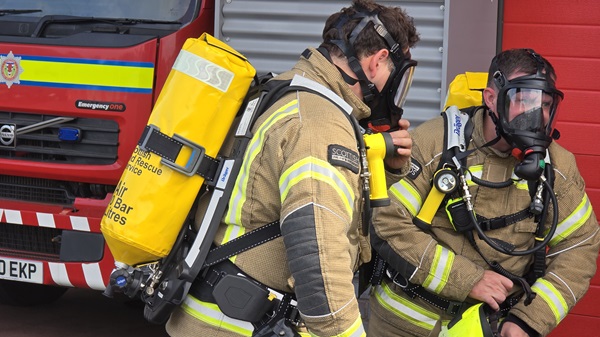
Dräger, an international leader in the fields of medical and safety technology, has been awarded a major new contract by the Scottish Fire and Rescue Service (SFRS) to provide a respiratory protection capability to enhance firefighter safety, operational readiness and national resilience.
The contract is designed to support SFRS across the full lifecycle of its respiratory protection capability, from introducing technology and ensuring comfort and performance through face fit testing, to building firefighter competency, equipment maintenance and support, and supporting operational readiness over the contract term. Dräger will provide face-fit testing and training for a firefighter population of more than 6,000 across Scotland, alongside ongoing support throughout the contract.
Separately, a formal framework has been established to research and assess new technologies that could enhance firefighter safety and strengthen resilience over time.
Awarded following a competitive procurement process that included a two-week evaluation by operational firefighters, the contract will support SFRS operations across Scotland, covering 356 fire stations. The scale of the provision is intended to strengthen SFRS’ operational resilience, including during periods of sustained or increased operational demand.
The equipment will be used in frontline operations, general training, and Compartment Fire Behaviour Training, while reserve stock will help maintain operational resilience during equipment servicing. In addition, Dräger’s TotalCare service package will provide servicing, maintenance and ongoing support throughout the contract.
In addition to its holistic, end-to-end support, among the key reasons SFRS selected Dräger was the PSS® AirBoss Connect Self-Contained Breathing Apparatus’ improved ergonomics, simple handling and telemetry capability. Its lightweight design is intended to support firefighter mobility and help reduce physical strain, while telemetry and enhanced communications support monitoring, situational awareness and decision-making on the fireground.
The equipment’s ease of cleaning will support SFRS’s investment in mechanical cleaning solutions, designed to help reduce firefighters’ exposure to carcinogens and other contaminants that can become embedded on equipment.
Assistant Chief Officer Craig McGoldrick who is the Director of Training, Safety and Assurance at SFRS said: “Protecting the health, safety and wellbeing of our firefighters is central to this investment, which is why operational firefighters played an important role in evaluating the equipment.”
“The new breathing apparatus, telemetry and communications capability will support firefighter safety, situational awareness and operational effectiveness. We will introduce the equipment through a carefully managed programme of training, face-fit testing and phased implementation to maintain operational resilience throughout the transition.”
Matthew Evans, Head of Government for UK and Ireland at Dräger, says the business is proud to be working with SFRS on this important programme: “Protecting firefighters begins long before they arrive at an incident. It relies on breathing apparatus that fits properly, training that gives crews confidence in its use, and the ongoing care needed to keep it ready for service. Bringing these elements together will help SFRS sustain a respiratory protection capability both its firefighters and communities can depend on.
“Our priority now is to make the transition to the new equipment as smooth as possible for firefighters across Scotland and we look forward to supporting SFRS throughout the contract.”
A managed implementation programme is already in place to support the transition from legacy equipment to the new system. Dräger and SFRS’s implementation and mobilisation teams will coordinate the rollout by district. The first equipment is expected to go live in spring 2027, with the rollout scheduled to be fully operational in 2028.
