




From policy to practice: What my internship taught me about making strategy real.
An MSc Finance intern’s perspective on Scottish business strategy.
Three minutes into Charandeep Singh’s answer at Scotland 2050, I stopped taking notes and started watching the room.
The Scottish Chambers of Commerce, Chief Executive had just said something that sounded almost casual: “Drift is where I see the most risk.” He wasn’t talking about vague political lethargy. He meant something precise, strong policy that starts with the right people in the room, then slowly loses momentum until everyone is revisiting the same questions a year later. The word stuck with me.
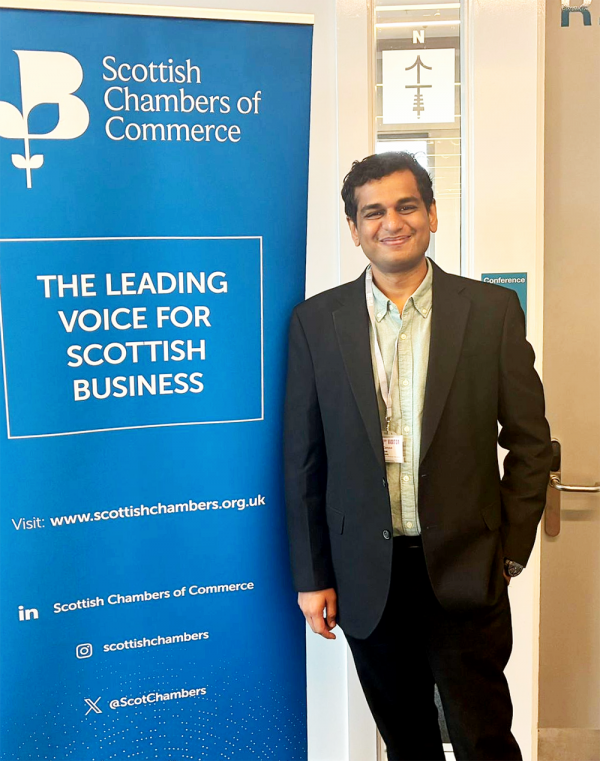
Six weeks into my internship at Scottish Chambers of Commerce, I thought I understood economic strategy. I’d studied the frameworks, read the policy documents, sat in on the planning conversations. But watching Charandeep field questions from academics, chief executives, and civil servants, I realised I’d been missing something fundamental: the distance between a strategy on paper and a strategy that changes someone’s day.
That distance became impossible to ignore a few weeks later. I was fortunate to sit in on the Pakistan Business Delegation meeting hosted at the chambers, with the Consul General of Pakistan present alongside a room full of South Asian business owners and Scottish sector leaders. What stayed with me wasn’t any single agenda item, it was the pattern underneath the conversation.
Around that table sat genuine capacity on one side and genuine need on the other. A youthful, energetic workforce looking for international opportunity. Scottish sectors that couldn’t fill their vacancies domestically. Established diaspora entrepreneurs who understood both markets intimately. Everything required for a thriving trade relationship was physically in the room. What was missing was the connective tissue, the named contact, the clear route, the institution willing to translate goodwill into a working pipeline.
Watching that, I finally understood what Charandeep meant by drift. It isn’t a failure of ambition or a shortage of resources. It’s what happens when two sides who could genuinely help each other simply cannot see the path between them. And that gap is exactly where drift takes hold, and exactly why the chambers exist: they hold the relationships and follow-through that turn a good meeting into an actual outcome.
I recognised it because it echoes the problem, I’ve spent my career on. My work has been in lending, and what I’m building towards comes down to something simple: helping someone reliable, who doesn’t fit the standard mould, be seen by the people who’d readily back them. In that meeting I was watching the same thing play out between whole economies rather than for one person, two sides who should do business, unable to see the route to each other. The internship took something I understood at the smallest scale and showed it to me repeating at the scale of nations.
So, two months in, I’ve learned that the meaningful work isn’t authoring grand strategy. It’s the patient, specific craft of connecting a person with a problem to a person who can solve it and doing it again. The chambers holds the relationships, the institutional memory, and the credibility earned over decades, and when that gets deployed thoughtfully, friction that once seemed permanent quietly dissolves.
I’m genuinely grateful to Charandeep and the whole Scottish Chambers of Commerce team for letting an intern into rooms like these, and for treating my questions as worth answering. I came here to learn how Scottish business works and every week I’m finding the lens sharper, both for the dissertation ahead and for the way I’ll think about this work long after.
Manan Goradia is an MSc Finance student at the University of Strathclyde and was a Business Operations Intern at Scottish Chambers of Commerce.
