




By Charandeep Singh, Chief Executive, Scottish Chambers of Commerce
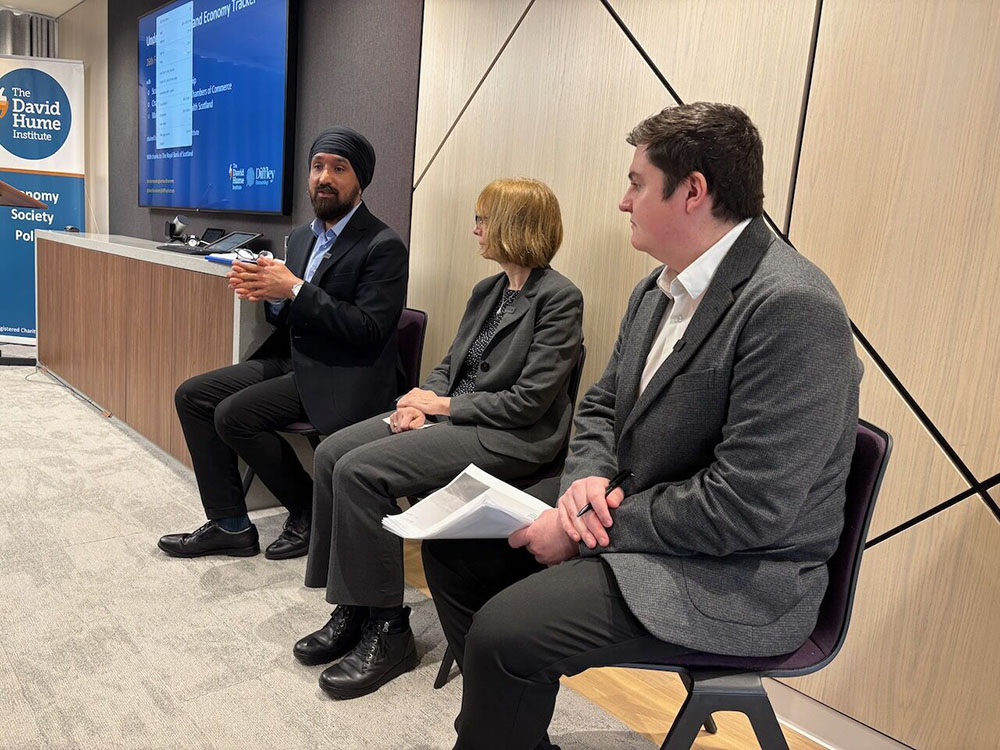
In March, I had the opportunity to join the David Hume Institute panel for the launch of the latest Understanding Scotland Economy Tracker.
A crisp early morning start, the event was held in the light-filled Carnegie Room at RBS on George Street, and I was sitting alongside Scott Edgar and Dr Margaret Douglas. As Scott took us through the Economy Tracker’s findings, I was struck by how closely the data reflected the conversations I’ve been having with businesses across Scotland.
The public’s lived experience, the pressures on households, the strain on the workforce, and the hesitancy in business investment are not disconnected issues. They are part of the same system, and the data shows the system is signalling stress.
What follows are some personal reflections, and key insights I took away from the discussion.
1. Easing pessimism is welcome, but it is not recovery
The tracker data suggested a slight easing of overall economic pessimism, offering a faint glimmer of hope. But let’s be clear: feeling slightly less bad is a far cry from a robust recovery. This easing hasn’t yet translated into stronger consumer confidence or an uptick in spending power. Household strain remains stubbornly widespread, with essential goods remaining expensive, hard-earned savings eroding, and overall wellbeing under serious pressure.
During the Q&A portion of the event, one perceptive audience member pointed out a fascinating disconnect in the Scottish economy: the glaring gap between how the public feels, how domestic businesses feel, and how Foreign Direct Investors (FDI) view us. It’s a brilliant observation. When we look at domestic businesses – particularly SMEs in retail, hospitality, tourism, and local services – they are staring down an unpredictable trading environment with inconsistent demand and ever-tightening margins. Put simply: until households feel genuinely secure, any sustainable business recovery will simply remain out of reach.
Yet, from the outside looking in, foreign investors see a highly educated workforce, world-class universities, and immense potential in renewable energy and green freeports. They are playing a ten-year horizon game, whereas our domestic firms are rightly worried about surviving today and tomorrow. Firms and consumers are fighting the same battle – whether we want to call it a ‘cost of living crisis’ or a ‘cost of doing business crisis,’ they are two sides of the same coin.
2. We cannot build a productive economy on an exhausted workforce
One of the most sobering findings from the tracker was the sheer impact of financial pressure on people’s ability to perform in the workplace. Many respondents explicitly reported significant mental health impacts, a feeling of reduced effectiveness, and consistently heightened stress levels. For our small and medium-sized businesses, where absolutely every role is pivotal to the bottom line, this translates into immediate, severe operational consequences.
At the same time, employers are actively contending with rising costs across the board, from labour and tax to energy and property. This severely limits their financial capacity to support their staff in the ways they ideally would like to. A stressed workforce combined with squeezed employers is a recipe for stagnation; it simply cannot deliver the vital productivity gains that Scotland so urgently needs.
Access to international talent is vital for Scotland’s economic success. However, Westminster’s increasingly restrictive and constantly shifting immigration policies are making the UK a far less attractive destination compared to other countries. This poses a real risk to Scotland’s key sectors – including life sciences, research, technology, and tourism – all of which depend on a diverse and inclusive workforce. From a business perspective, the simple reality is that Scotland relies heavily on global skills, and current immigration decisions undermine our competitiveness.
But we also have to look after the talent we already have here. That means creating the conditions for people to stay, thrive and progress in their careers. Flexible working isn’t a fashionable benefit aimed only at young graduates; it has become an economic necessity for the twenty-first century. Our workforce is made up of people with diverse responsibilities and life circumstances: older workers who need time for health appointments, parents managing childcare, individuals with caring responsibilities, and employees who simply work better when given autonomy over how and when they deliver. If we want to increase participation, boost productivity, and retain experienced talent, we must embrace flexibility as a core part of Scotland’s competitive advantage.
3. Structural cost pressures are reshaping business behaviour
Make no mistake: the pressures currently facing businesses are deep, structural, and not merely temporary. Surging labour costs, stubbornly high energy bills, and tax divergence from the rest of the UK are fundamentally altering how business decisions are being made. As a result, investment is actively being delayed, hiring has become far more cautious, and margins are tightening to the breaking point. Unsurprisingly, business confidence is weakening. For the first time in years, we are in a position where more firms actually expect their turnover to fall rather than rise.
Crucially, investment intentions are moving in entirely the wrong direction. Without confident investment, we simply cannot lift productivity. Without productivity gains, wages will stagnate. And without stronger wages, that household strain we discussed earlier will only continue. These issues are inextricably interconnected.
4. Young people need to be supported through the economic transition
This brings me to a particularly poignant moment from the event. A young audience member, who was around ten years old during the 2008 financial crash, asked how young people can find motivation when all they’ve known is a “stew of economic pessimism.” My answer to him, and to the wider business community, is that we must embrace this era, and be clear-eyed about the challenges and opportunities it presents. The world has fundamentally changed in the last twenty years, and there is no going back to the pre-2008 economy. The key is to be agile, flexible and adaptable. There is hope and we have to champion the opportunities for the next generation.
This agility is especially critical as we face the tidal wave of artificial intelligence (AI) and digital disruption. AI promises massive long-term productivity boosts, but we need to be serious about training and upskilling the workforce to make the most of this technology. That won’t happen until the government commits to funding this training, signalling that they are in this for the long haul.
Additionally, if our businesses are bogged down by the day-to-day cost of simply existing, they won’t have the capacity to invest in AI, risking falling behind global competitors. This is why Scotland needs robust digital infrastructure, like the new data centres opening in Lanarkshire, as well as a pivot towards agile, vocational training like apprenticeships to prepare our workforce for jobs that look very different from the ones that existed a decade ago.
5. A Call to Action
One conclusion is inescapable: Scotland’s economic prospects depend on whether businesses have the confidence and capacity to invest, hire, innovate, and grow.
A stronger economy, better living standards, and better-funded public services all flow from a competitive, thriving business base.
Scotland now needs to focus on five practical priorities: competitiveness, infrastructure, skills, digital, and international trade. SCC has a clear vision for how we will make progress on these issues, grounded in insights from our members across the country, and backed by credible and deliverable targets across the lifetime of the next Scottish Parliament.
Over the coming weeks, we hope that the call of the business community will be answered by our politicians; SCC will work with any leader whose ambitions match those of Scotland’s hardworking and innovative entrepreneurs.
Scotland is rich in enterprise, talent and ambition. What we need now is an environment that allows businesses to shift decisively from surviving to investing. That will require a laser-like focus on competitiveness, and a willingness to listen to business.
