




Scotland’s economic ambitions will ultimately be delivered by businesses: by firms investing, creating jobs, developing new products and services, and finding new markets at home and overseas.
For the Scottish Chambers of Commerce (SCC), that means ensuring Scotland creates a stronger environment in which businesses can grow at home, while giving more of our companies the confidence and connections to compete internationally.
That has been a central focus of our work over recent months.
Across Scotland, we have been spending time with local Chambers and their members to understand how national economic challenges are being experienced in different parts of the country. Issues such as skills shortages, infrastructure, business costs and access to investment are common across the network, but their impact varies significantly between places and sectors.
Our recent visit to the Cairngorms brought together the chief executives of Cairngorms Business Partnership, Inverness, North Highland and West Highland Chambers of Commerce to discuss the opportunities and constraints facing businesses across the region. Our Presidents’ Lunch similarly brought together Chamber leaders from Edinburgh, Leith, West Lothian, Inverclyde, Glasgow and Lanarkshire to consider both regional priorities and the wider conditions required for growth.
At Inverness Chamber’s Highland Dinner, SCC Chief Executive Charandeep Singh BEM also set out his view that much of Scotland’s future economic opportunity will be shaped by the Highlands, from renewable energy and infrastructure to tourism, food and drink and international investment.
Scotland will not deliver sustainable national growth without strong regional economies. Policy needs to recognise the different economic strengths of our cities, towns and rural communities, while removing the barriers that prevent businesses from investing and expanding.
SCC has been taking that message directly to Scotland’s political and economic decision-makers.
Following the Scottish Parliament election, we have engaged with newly elected and returning MSPs on the priorities businesses want to see reflected in the new parliamentary term: reducing the cost of doing business, accelerating infrastructure delivery and developing a skills system that responds more closely to employer demand.
Those themes have also shaped our contributions to wider discussions including Scotland 2050 and the Colleges Scotland annual conference. Scotland’s long-term competitiveness will depend on how effectively business, education and public institutions work together to increase productivity, develop talent and turn innovation into commercial opportunity.
The same applies internationally.
Scotland is an outward-looking economy, and increasing exports, attracting investment and building stronger international commercial relationships will be central to improving productivity and generating sustainable economic growth.
SCC has continued to strengthen its engagement with the wider British and international Chamber movement.
At the British Chambers of Commerce Global Annual Conference, we shared Scotland’s experience of supporting businesses into international markets and highlighted the success of the International Trade Partnership between the Scottish Chambers of Commerce Network and the Scottish Government.
Through that partnership, more than 1,000 Scottish SMEs have been supported to internationalise and explore opportunities in markets around the world. There is considerable scope to build on that platform, particularly by helping SMEs with limited previous exporting experience take their first steps into overseas markets.
Our relationship with the United States remains an important part of that work.
As the US marks 250 years since independence, the anniversary provides an opportunity not simply to celebrate the historic links between Scotland and America, but to consider how that relationship can continue to develop economically.
The United States is Scotland’s largest international export market and a major source of inward investment. Through trade missions, business connections and collaboration with partners on both sides of the Atlantic, the Chamber Network is working to turn those long-standing ties into new commercial opportunities.
Glasgow Lord Provost Councillor Dr Jacqueline McLaren, reflecting on recent engagement in the United States, highlighted the importance of using these opportunities to promote Scotland’s cities, businesses and educational institutions and strengthen their international profile.
India represents another major opportunity.
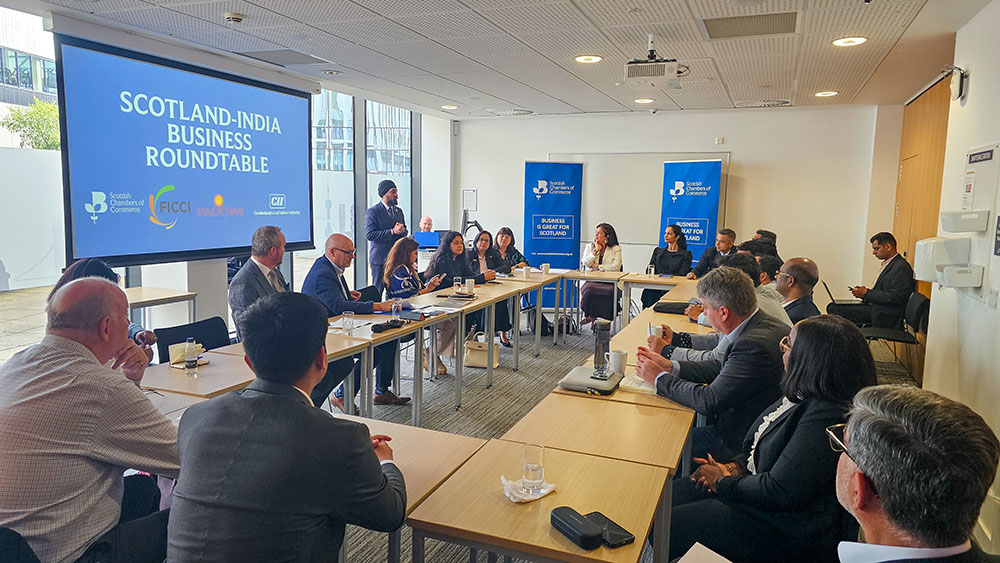
Following SCC’s Memoranda of Understanding with the Federation of Indian Chambers of Commerce and Industry (FICCI) and the Associated Chambers of Commerce and Industry of India (ASSOCHAM), we recently welcomed an Indian business delegation to Scotland.
The visit came as the UK-India Free Trade Agreement created a new framework for businesses to trade and invest. Agreements between governments can open doors, but businesses still need relationships, market knowledge and trusted partners to turn that access into commercial activity.
That was the focus of the Scotland India Business Forum and a subsequent programme of business engagement organised by SCC alongside FICCI, ASSOCHAM and the Confederation of Indian Industry.
Scottish and Indian businesses explored opportunities across manufacturing, engineering, energy, education, life sciences, healthcare and trade. SCC also welcomed Raghav Singhal, Chief Executive Officer of ICICI Bank UK, to meet our Board and discuss the practical opportunities and challenges facing companies seeking to expand between the two markets.
Delegates also visited City of Glasgow College’s Riverside Campus and its maritime simulation facilities, showcasing Scotland’s skills, education and institutional expertise.
The value of this work will be seen in the commercial relationships, investment decisions, partnerships and export opportunities that follow.
The Chamber model is well placed to support that process. Local Chambers understand the businesses and economies they represent. SCC can connect those insights to national decision-makers and, through the wider Chamber movement and our international partnerships, open doors into markets around the world.
Scotland needs an economic environment that gives businesses the confidence to invest at home, alongside an international strategy that helps ambitious firms compete abroad.
For SCC and the Chamber Network, our role is to strengthen those connections: between local businesses and national government; between employers and the skills system; between Scottish companies and international markets; and between Scotland’s economic strengths and the investment needed to develop them.
That is how Scotland turns economic potential into growth, at home and abroad.
